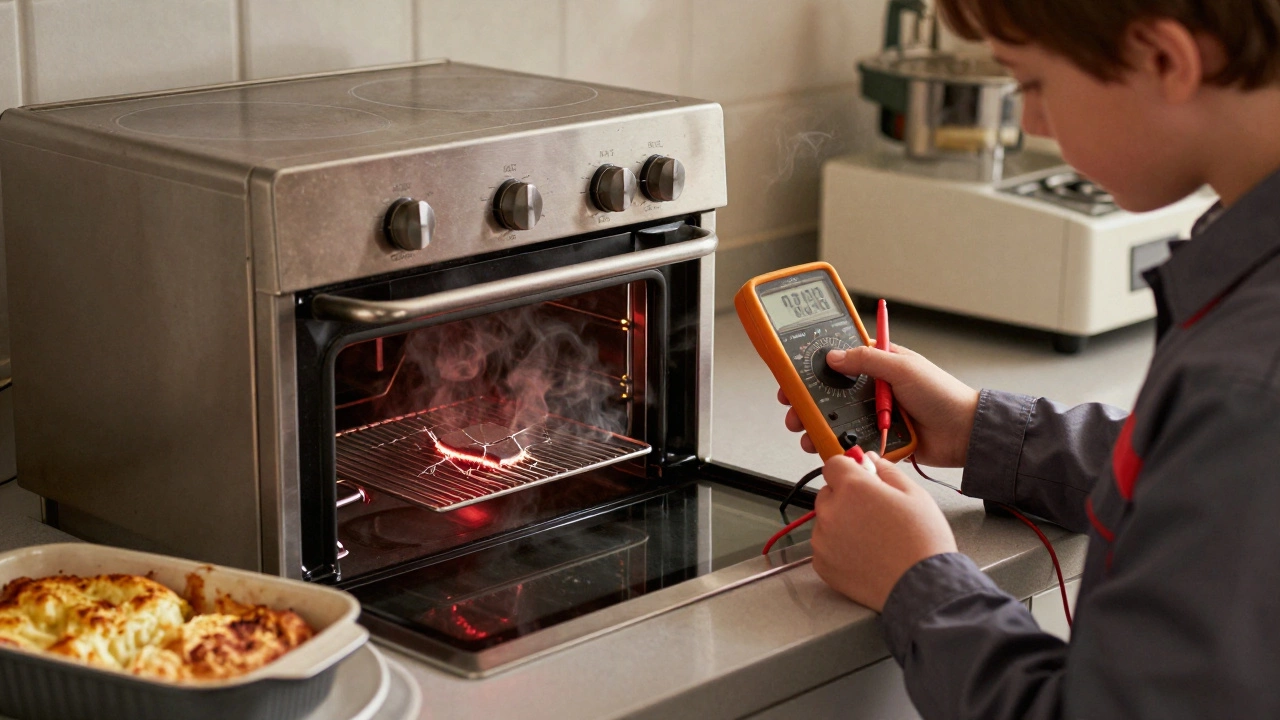
Oven Repair vs. Replacement Calculator
Five years isn’t a long time for an oven. But if yours is acting up-burning food unevenly, not heating at all, or throwing error codes-you’re probably wondering: is it worth repairing a 5-year-old oven? Or should you just buy a new one? The answer isn’t simple. It depends on what’s broken, how much it costs to fix, and what you expect from your oven in the next few years.
Most Common Problems in 5-Year-Old Ovens
Ovens that fail around the five-year mark usually have one of three issues: a faulty heating element, a broken thermostat, or a malfunctioning control board. These aren’t rare. In fact, about 60% of oven repairs in this age range involve one of these three parts.
The heating element is the easiest to spot. If the bottom or top coil isn’t glowing red when the oven is on, it’s dead. Replacing it costs between $50 and $150, including labor. It’s a 30-minute job for a technician.
The thermostat is trickier. If your oven says it’s at 350°F but your oven thermometer says 310°F, the sensor is off. Replacing the thermostat costs $80-$180. It’s not a DIY fix unless you’re comfortable with electrical wiring.
The control board is the most expensive. If your oven won’t turn on, the display is blank, or buttons don’t respond, the board might be fried. Repairing this can run $250-$500. That’s a red flag. Control boards rarely fail unless there’s a power surge, water damage, or poor manufacturing.
Repair Costs vs. New Oven Prices
Let’s compare numbers. A typical repair for a 5-year-old oven-say, a new heating element and thermostat-runs $200-$300. That’s less than half the price of a basic new oven.
But here’s the catch: new ovens aren’t cheap. A standard 30-inch electric range starts at $600. Mid-range models with convection, self-cleaning, and smart features cost $900-$1,500. High-end models go over $2,000.
So if your repair bill is under $400, you’re saving money. If it’s over $500, you’re close to buying new. And if the repair is $600 or more? You’re better off replacing it. Why? Because you’re paying for a 5-year-old appliance to last another 2-3 years, max. New ovens come with 1-year warranties, and many brands offer 5-year coverage on parts.
Energy Efficiency: The Hidden Factor
Five-year-old ovens are usually not energy efficient by today’s standards. Newer models use 15-25% less electricity. That might not sound like much, but if you bake often, it adds up.
Let’s say you use your oven 3 hours a week. A 2020 oven might pull 2.5 kW per hour. A 2025 model pulls 1.9 kW. That’s a 0.6 kW difference. At $0.15 per kWh, you save $0.09 per hour. Over a year, that’s $14.04. Over five years? Around $70.
That’s not enough to cover a new oven. But if you’re replacing it anyway, you’re getting a more efficient appliance. And if your utility company offers rebates for Energy Star models, you could get $50-$100 back. That helps.
Warranty and Reliability
Most ovens come with a 1-year full warranty. Some brands, like Whirlpool and GE, offer extended coverage on key parts for up to 5 years. If your oven is still under warranty, repair it-no question.
But if the warranty expired at year 3, and you’re now at year 5, you’re on your own. That’s when reliability drops. Parts start wearing out faster. One repair often leads to another. A 2021 study by Consumer Reports found that ovens over 4 years old are 3 times more likely to need a second repair within 12 months.
That’s the real cost: not just the money you spend now, but the stress of it breaking again in 6 months. If your oven is already acting up, it’s not just broken-it’s unreliable.
When to Walk Away
Here’s when you should skip the repair and buy new:
- The repair cost is over 50% of a new oven’s price
- The oven has multiple issues (e.g., element + control board)
- You’ve already repaired it once in the last 12 months
- The oven is not energy efficient (no Energy Star label)
- You’re planning to move in the next 2 years
And here’s when repair makes sense:
- It’s a single, simple fix under $250
- The oven is a high-end model you love (like a Viking or Wolf)
- You’re on a tight budget and need time to save
- The oven is built like a tank (older models from the 2000s often are)

What to Look for in a New Oven
If you’re replacing it, don’t just buy the cheapest one. Look for these features:
- Convection cooking: Cools food faster and more evenly
- Self-cleaning: Saves hours of scrubbing
- Smart features: Remote start, temperature alerts, app control
- Warranty: At least 1 year full, 5 years on parts
- Energy Star rating: Saves money long-term
Brands like Bosch, Frigidaire, and LG offer reliable models under $1,000. Avoid no-name brands. They often cut corners on wiring and insulation, leading to early failures.
What to Do Next
Don’t guess. Get a quote.
Call a local appliance repair technician. Ask them to diagnose the issue and give you a written estimate. Make sure they tell you the part number and brand. Then, go online and check the price of a new oven with similar features.
If the repair is under $300 and the oven still heats well, fix it. If it’s over $400 and you’re tired of the problems, replace it.
And if you’re unsure? Wait 2 weeks. If the oven keeps working fine, you might be able to delay the decision. But if it’s getting worse? Don’t wait. A broken oven on Thanksgiving is a nightmare you don’t need.
Final Thought
Repairing a 5-year-old oven isn’t always a bad idea. But it’s not always smart either. You’re not just paying for a part-you’re paying for peace of mind. If the repair gives you 2-3 more years of reliable use, go for it. If it’s a temporary fix, you’re just delaying the inevitable. And in that case, buying new might save you more than money-it might save your sanity.
I am an expert in the services industry with a focus on appliance repair. My passion lies in understanding how things work and educating others in simple, engaging ways. This enthusiasm fuels my writing, where I delve into topics around appliance maintenance and troubleshooting. I aim to make these subjects clear and accessible to all readers.